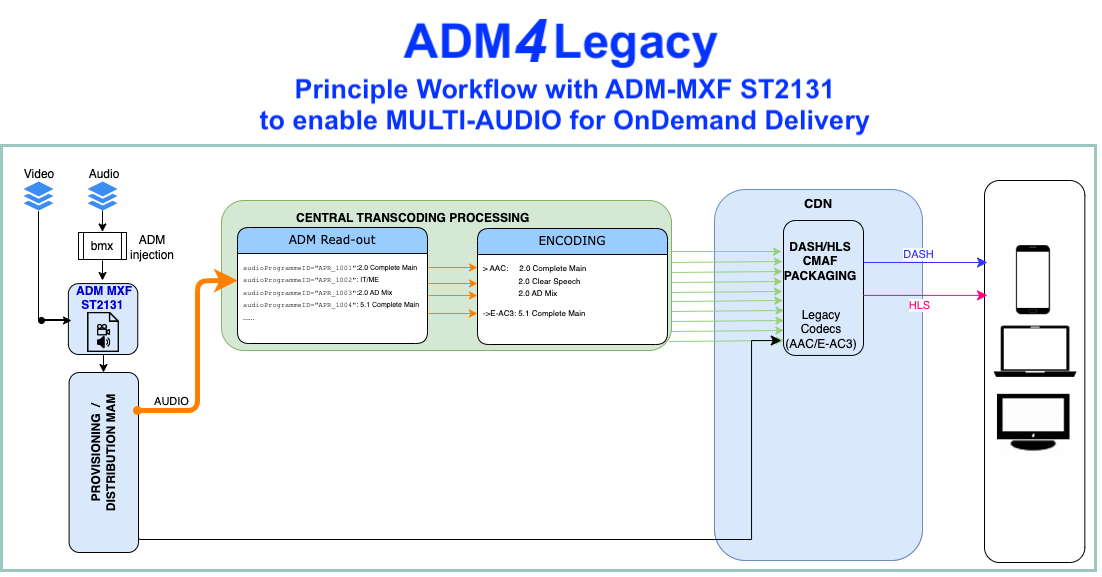
ADM4Legacy - Stage 1 Workflows
ADM can enhance "legacy" MXF assets containing channel-based mixes defined in track-allocation tables such as EBU R123, ITU-R BS.2102 or ARD/ZDF/ORF's Delivery Specifications TPR
Instead of applying sidecar-files (e.g. the outdated BMF - Broadcast Media ExchangeFormat) or even paper sheets (MBK - Medienbegleitkarte et. al.), ADM wrapped in MXF according to SMPTE ST 2131 can carry all necessary information about audio formats (2.0, 5.1), content type (Complete Main, IT/ME...), loudness metadata etc. within the MXF essence.
This allows more consistent and (semi-)automated workflows for both On-Air and On-Demand distribution pipelines.
Especially human curated provisioning On-Demand presently lacks solid information about available audio tracks contained in order to trigger the required encoding parameters and enabling MULTI-AUDIO also for HLS and DASH streaming. Thus, audiences cannot benefit from better audio experiences by selecting AD or clear speech dialogue or surround sound when accessing content via streaming.
This STEP 1 workflow show the improvements that can be gained
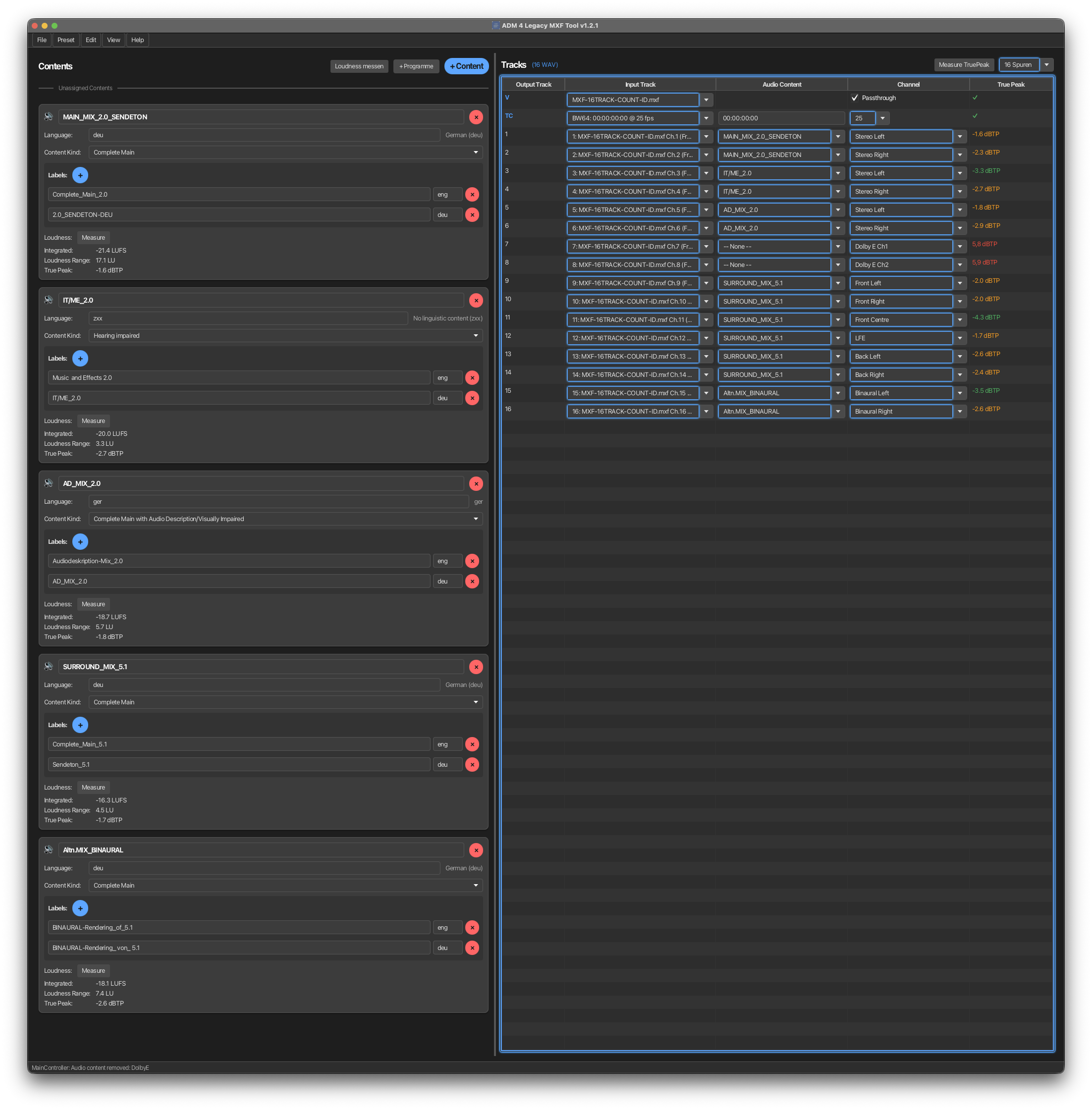
ADM4Legacy Tool
ARD-HR has developed a tool to enhance conventional MXF OP1A assets with ADM metadata according to SMPTE ST 2131. Based upon bmx and ffmpeg, this GUI tool clearly demonstrates the benefits to be gained.
ADM4Legacy applies the best-practices described on the MXF & IMF Best Practice and ADM Attributes and MCA Properties